

Takeaways
- Malaysia’s NSRF aligns sustainability reporting with the IFRS S1 and IFRS S2 standards.
- Implementation is phased for Main Market, ACE Market and large non-listed companies from 2025 onwards.
- Companies must disclose material climate-related governance, strategy, risks, opportunities, metrics and targets.
- Robust Scope 1 and Scope 2 GHG emissions data will be critical for credible reporting and future assurance readiness.
- Scope 3 emissions and broader sustainability disclosures will become increasingly important after the transition period.
Malaysia’s National Sustainability Reporting Framework (NSRF) is changing sustainability reporting from a standalone communications exercise into decision-useful corporate reporting connected to governance, strategy, risk and financial performance.
For companies in scope, the question is no longer whether to prepare. It is whether the organisation can produce credible, connected and verifiable climate disclosures on time. The answer depends on coordinated work across the board, finance, sustainability, operations, risk, procurement and internal audit.
This guide explains the NSRF, who is affected, the phased implementation timeline, the transition reliefs available, and what Malaysian companies should do now.
Table of Contents
What is Malaysia’s National Sustainability Reporting Framework (NSRF)
Launched on 24 September 2024, the NSRF is Malaysia’s framework for adopting the IFRS Sustainability Disclosure Standards issued by the International Sustainability Standards Board (ISSB):
- IFRS S1 — General Requirements for Disclosure of Sustainability-related Financial Information
- IFRS S2 — Climate-related Disclosures
The framework aims to improve the availability of reliable, comparable and decision-useful information about material sustainability-related risks and opportunities. It also supports the flow of sustainability information through supply chains and allows companies to use complementary frameworks, such as GRI and SASB, where useful for stakeholder needs.
NSRF reporting is not simply an ESG scorecard. The disclosures are intended to help investors and other primary users understand risks and opportunities that could reasonably be expected to affect a company’s prospects, including cash flows, access to finance and cost of capital.
Who Needs to Comply and When
NSRF divides entities into three groups:
- Group 1:Main Market–listed issuers with a market capitalisation of RM2 billion or more and above.
- Group 2: All Main Market–listed issuers apart from Group 1.
- Group 3: ACE Market-listed firms and large non-listed firms with annual revenue of RM2 billion and above two consecutive financial years.
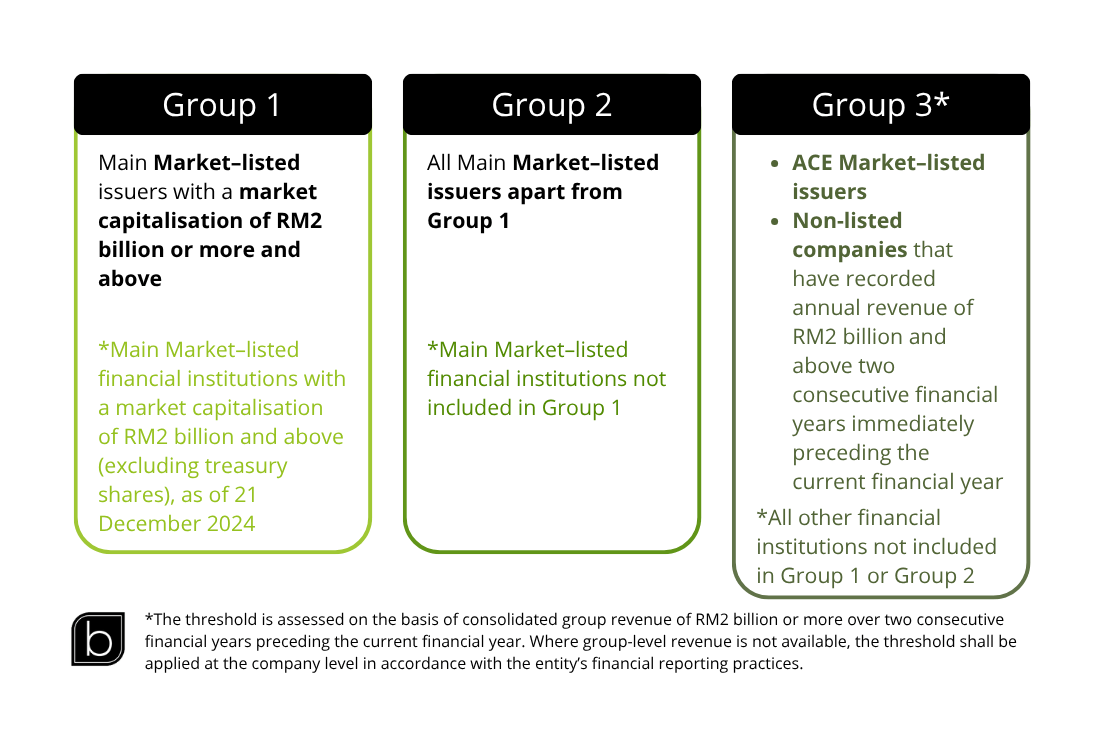
For a large non-listed company, the RM2 billion threshold is based on consolidated group revenue for two consecutive financial years before the current financial year. Where consolidated group revenue is unavailable, the company-level threshold applies.
Companies outside these categories may still face climate-data requests from customers, lenders, investors, export markets and supply-chain partners. Voluntary early preparation can therefore be commercially important, particularly for companies in hard-to-abate sectors or CBAM-related value chains.
Implementation Timeline
The NSRF uses a phased, climate-first approach. This allows companies to focus initially on climate-related risks and opportunities under IFRS S2, while applying IFRS S1 insofar as it relates to climate.
| Reporting topic | Group 1 | Group 2 | Group 3 |
|---|---|---|---|
| First reporting period under IFRS S1 and IFRS S2 | 2025 | 2026 | 2027 |
| Climate-first transition relief ends; broader sustainability-related disclosures become required | 2027 | 2028 | 2030 |
| Expected disclosure of relevant Scope 3 GHG emissions | 2027 | 2028 | 2030 |
| Proposed reasonable assurance for Scope 1 and Scope 2 GHG emissions* | 2027 | 2028 | 2029 |
*The reasonable-assurance timetable remains subject to further consultation by the Advisory Committee on Sustainability Reporting (ACSR) and its Sustainability Assurance Working Group. Companies should prepare early rather than assume the eventual assurance requirement will be delayed.

What Disclosures Must Be Made
IFRS S1 and IFRS S2 require material information to be connected across four core areas.
1. Governance
Explain how the board and management oversee climate-related risks and opportunities. This includes the responsible committee or board, the frequency and quality of information received, management roles, escalation procedures, and how oversight connects to strategy and remuneration where relevant.
2. Strategy
Describe the climate-related risks and opportunities that could reasonably affect the company’s prospects. Explain where they arise in the business model and value chain, the anticipated effects on strategy and financial planning, and how resilient the strategy is under climate-related scenario analysis.
3. Risk management
Show how climate-related risks are identified, assessed, prioritised and monitored, and how those processes are integrated into the company’s overall enterprise risk-management process.
4. Metrics and targets
Report the metrics used to measure and manage material climate-related risks and opportunities. This includes Scope 1 and Scope 2 GHG emissions, relevant industry-based metrics, targets, progress against targets and, once the relevant transition relief ends, Scope 3 GHG emissions.
Key NSRF transition reliefs
The NSRF provides reliefs to support a practical transition, but a relief is not a substitute for a preparation plan. Companies using a relief should explain why the relevant disclosure has not yet been provided.
For the first two reporting periods for Groups 1 and 2, and the first three reporting periods for Group 3, applicable entities may:
- Focus disclosures on climate-related risks and opportunities.
- Focus climate-related disclosures on principal business segments.
- Omit Scope 3 GHG emissions, except where a regulator already requires specific categories.
Other important points include:
- The NSRF does not adopt the ISSB first-year relief that would allow sustainability disclosures to be reported after the related financial statements. Applicable entities should follow their regulator’s requirements on reporting location and timing.
- IFRS S2 requires GHG emissions to be measured using the GHG Protocol. A company already using another method may use the first-year transition relief, but should plan to transition thereafter.
- Proportionality mechanisms allow companies to use reasonable and supportable information available without undue cost or effort. In some cases, qualitative approaches may be appropriate—for example, in scenario analysis or assessing financial effects—where skills, capabilities or resources are limited.
What does the NSRF mean for boards and management?
The NSRF elevates sustainability reporting to a board and finance issue. A credible report requires more than a sustainability team compiling narratives at year-end.
Boards should ensure that management can answer five questions:
What climate-related risks and opportunities could affect our business model, strategy and financial outlook?
Who owns the related data, assumptions, controls and final disclosures?
Can we explain how climate risks are reflected in risk management, budgeting, capital expenditure and financial planning?
Are our Scope 1 and Scope 2 emissions data traceable from source records to reported figures?
What is our plan for Scope 3, scenario analysis and external assurance?
A 90-day NSRF action plan
Days 1–30: establish accountability and assess gaps
- Confirm the board committee and executive sponsor accountable for NSRF reporting.
- Form a cross-functional working group involving finance, sustainability, risk, operations, procurement, legal and internal audit.
- Determine the reporting entity, applicable group and reporting deadline.
- Perform a gap assessment against IFRS S1 and IFRS S2, covering governance, strategy, risk management, metrics and targets.
- Identify the principal business segments, major emissions sources and priority data owners.
Days 31–60: build the disclosure and data foundation
- Identify material climate-related risks and opportunities using financial materiality.
- Map the existing enterprise risk-management process and define how climate issues will be integrated.
- Establish a GHG inventory boundary and a Scope 1 and Scope 2 data-collection process aligned with the GHG Protocol.
- Create a data dictionary for each reported metric: definition, calculation method, source system, owner, review process, evidence retained and reporting frequency.
- Set a documented approach for climate-related scenario analysis that is proportionate to the business.
Days 61–90: prepare for reporting and assurance
- Draft a disclosure outline mapped to IFRS S1 and IFRS S2 requirements.
- Test the traceability of selected emissions metrics from meter, invoice, fuel record or operational source through calculation to disclosure.
- Create internal controls over data changes, calculations, approvals and management review.
- Agree a Scope 3 readiness plan, beginning with screening and prioritisation of the most material categories.
- Present the implementation roadmap, risks, resource needs and decisions required to the board or relevant committee.
Common NSRF reporting mistakes to avoid
1.Treating NSRF as a communications project
A well-designed report cannot compensate for weak governance, incomplete data or untested assumptions. Start with the management process and evidence trail, then write the report.
2.Reporting every ESG topic without financial materiality
The NSRF focuses on information material to primary users of general-purpose financial reports. A materiality process should be documented and tied to the company’s prospects, not simply a long list of popular ESG topics.
3.Leaving scenario analysis until the end
Scenario analysis informs strategy, risk management and financial planning. It should be designed early, using an approach proportionate to the company’s circumstances and available capabilities.
4.Confusing GRI reporting with IFRS S1 and IFRS S2 reporting
GRI can continue to serve broader stakeholder reporting needs, but it does not replace the investor-focused requirements of the ISSB Standards. Companies using GRI should assess the available ISSB–GRI interoperability resources and avoid obscuring material ISSB information.
5.Waiting for assurance requirements to be finalised
The proposed assurance timetable is a signal to start creating auditable data now. Retrospectively reconstructing source evidence is costly and often unreliable.
How Bernard Business Consulting can help
Bernard Business Consulting supports Malaysian companies in turning NSRF requirements into an achievable implementation programme. Our support can include:
- Sustainability Governance Setup
- IFRS S1 & S2 Gap and Readiness Assessment
- GHG Accounting
- Climate Scenario Analysis
- Double Materiality Assessment
- Sustainability Risk Management
- Sustainability and Climate Strategy Development
- Capacity Building and Training
- ESG and Sustainability Reporting
- ESG and GHG Reporting Software
NSRF readiness is not achieved through report writing alone. It requires connected action across governance, sustainability risk management, climate analysis, GHG accounting, strategy, capability building, data management and reporting.
Contact us to find out how Bernard Business Consulting can support your organisation with practical advisory, training, reporting and implementation support related to NSRF readiness, IFRS S1 and IFRS S2 gap assessments, sustainability governance, GHG accounting, climate scenario analysis, double materiality, sustainability risk management, strategy development and assurance-ready ESG reporting.
Related guides
- NSRF Readiness Checklist: Key ESG Actions Every Malaysian Public Listed Company Should Take
- ESG Governance Structure for Malaysian Companies: How to Define Board Oversight, Management Roles and Accountability
- Sustainability Risk and Opportunity Assessment in Malaysia: How Companies Can Prepare for IFRS S1 and NSRF Reporting
- Climate Risk and Opportunity Assessment in Malaysia: A Practical Guide to Qualitative Climate Scenario Analysis under IFRS S2
- GHG Scope 1 and Scope 2 Verification in Malaysia: What Companies Need to Prepare Before NSRF Assurance Starts in 2027
Official sources and further reading
- Securities Commission Malaysia: National Sustainability Reporting Framework
- Securities Commission Malaysia: NSRF policy documents and implementation resources
- IFRS Foundation: Sustainability knowledge hub
This article is general information, current as at 10 August 2026. It is not legal, accounting or assurance advice. Requirements and implementation guidance may change; companies should confirm their obligations with qualified advisers and the relevant regulator.

Webinar
Understanding Malaysia’s National Sustainability Reporting Framework
Gain practical insights into Malaysia’s National Sustainability Reporting Framework (NSRF), its links to IFRS S1 & S2, and actionable steps for compliance, governance, and value creation.

eBook
The C-Suite Guide to Malaysia’s National Sustainability Reporting Framework (NSRF)
Developed by BBC’s ESG and sustainability consultants, this practical roadmap guide helps leaders understand, plan and apply the NSRF effectively. It provides a clear roadmap to strengthen governance, enhance reporting and create business value.